Delay & Reverb Time Calculator
Delay lengths for different note values in reference to your BPM
| Note Value | Notes | Dotted | Triplets |
|---|---|---|---|
| 1/1 (1 Bar) |
2000 ms / 0.5 Hz | 3000 ms / 0.33 Hz | 1333.33 ms / 0.75 Hz |
| 1/2 (2 Beats) |
1000 ms / 1 Hz | 1500 ms / 0.67 Hz | 666.67 ms / 1.5 Hz |
| 1/4 (1 Beat) |
500 ms / 2 Hz | 750 ms / 1.33 Hz | 333.33 ms / 3 Hz |
| 1/8 | 250 ms / 4.00 Hz | 375 ms / 2.67 Hz | 166.67 ms / 6.00 Hz |
| 1/16 | 125 ms / 8.00 Hz | 187.5 ms / 5.33 Hz | 83.33 ms / 12.00 Hz |
| 1/32 | 62.5 ms / 16.00 Hz | 93.75 ms / 10.67 Hz | 41.67 ms / 24.00 Hz |
| 1/64 | 31.25 ms / 32.00 Hz | 46.88 ms / 21.33 Hz | 20.83 ms / 48.01 Hz |
| 1/128 | 15.63 ms / 63.98 Hz | 23.44 ms / 42.66 Hz | 10.42 ms / 95.97 Hz |
| 1/256 | 7.81 ms / 128.04 Hz | 11.72 ms / 85.32 Hz | 5.21 ms / 191.94 Hz |
| 1/512 | 3.91 ms / 255.75 Hz | 5.86 ms / 170.65 Hz | 2.6 ms / 384.62 Hz |
Delay & Reverb Calculator
You can now also calculate your delay and reverb settings within the respective Android app.

Find the right time settings for your reverb!
Many professional audio engineers set their reverb according to the tempo of the song they are working on. The reason for this is to make the reverb vibe with the pulse of the track. With this handy Pre-Delay and Reverb Time Calculator, you can easily find out which pre-delay and decay time settings are likely to go with the BPM of your song. If you want to detect the BPM of a song check out the BPM Calculator.
A natural sounding reverb brings more life to your music
To get a natural sounding reverb the pre-delay is crucial. Humans are accustomed to hearing a specific delay before they hear a reverb. This gap is defined by the pre-delay of your reverb. In the calculator above you can find commonly used values for the pre-delay and the decay time. Adding or subtracting a few milliseconds from these timing values can create a pushing or pulling feel to your groove.
How to calculate the pre-delay of your reverb
1/64 delay time: 31.25 ms –> pre-delay time: 31.25 ms
1/2 delay time: 1000 ms –> decay time: 1000 ms – 31.25 ms = 968.75 ms
The second table shows you the delay lengths of different note values, which are a good starting point for your pre-delay and decay time. In this example, I took the 1/64 notes delay time as my pre-delay. Should the pre-delay be too long you can also take the 1/128 notes delay time. If it is too short you can also try out the 1/32 delay time.
Next, we want to adjust the decay time to fill the gap between the pre-delay and the total reverb time. I chose the delay length of a half note to create a small room. Now you just have to subtract the pre-delay from the total reverb time to get the decay time. Which in this example is 968.75 ms.
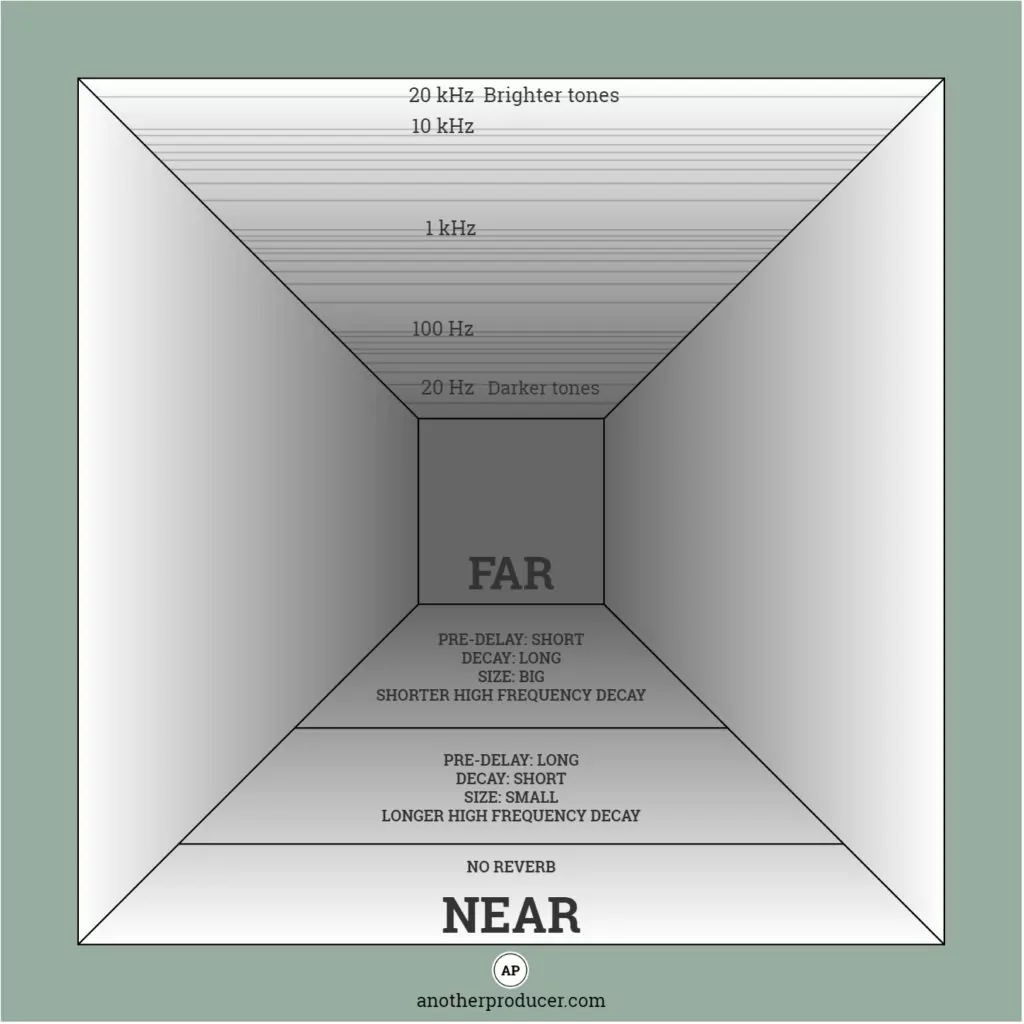
You can use different reverb settings for different instruments in your track to create depth. Strings, for example, can sound amazing with a long reverb tail while the kick drum maybe should stay up front (it all depends on what you want to create). But use this technique cautiously, as many reverbs can also destroy your mix. Especially if you only have instruments that would normally play in the same room. If this is the case, you can use the same room reverb on all instruments to create the feeling that all instruments are playing in the same place.
Some additional tips: Often a room reverb for a song is adjusted to the snare. The goal is that the reverb of one snare hit dies just before the next snare hit. While the snare most often comes on upbeats the half note delay is always a good starting point if you are in a 4/4 time signature, and your snare hits on the 2nd, and 4th beat. If your snare hits on the 3rd beat, you can try out the whole notes delay time as a total reverb time. To further clean up your mix try a low- (600Hz) and a high cut (ca600Hz) on your reverb. You can also put a compressor on your reverb send and sidechain it to the audio source so the reverb gets ducked when your instrument plays. You can find more information on how to mix reverb in this blog article by iZotope.
Delay Calculator to determine the right delay time for your song
You can use a delay to make your tracks more interesting by adding movement, and also depth. Timing the delay to the tempo of your track will create depth while the delay is not noticeable. But sometimes you also want the delay to be noticeable. For example, when you want to add movement. The Delay and Reverb Time Calculator can help you with both.
While most modern delay effects can be synchronized to the projects BPM some are not capable of doing this. The delay calculator helps you to find the right settings for your delay. For depth, just try out different delay times out of the normal notes list.
A great way to create movement is by adding multiple delays, with different timings. It even gets more interesting if you use triplets or dotted notes. For example, you can try using three different delays with three different delay lengths and pan them to the right, the center, and the left.
Furthermore, the delay calculator is very useful if you use guitar pedals, that allow you to enter a delay in milliseconds.
Tune your LFO to the tempo of your song
A low-frequency oscillator (LFO) is an electronic device (or software) which creates a rhythmic pulse or sweep that usually is below 20 Hz . This pulse is often used to modulate synthesizers, delay lines and other musical gear to create effects like vibrato, tremolo and phasing for example.
In addition to the milliseconds, the delay calculator also shows you the respective Hertz values for the various note values. Try some of them with your LFOs to create great effects that vibe with your tracks.
Reverberation — Calculator

RT60 = reverberation time in s S = absorbing surface in m 2
A = α1 × S1 + α2 × S2 + α3 × S3 + . . . c20 = 343 m/s at 20°C
RT60 is the reverberation time, the sound pressure level of a signal needs to decay to the value of (-) 60 dB.
k is a constant that equals 0.161 when the units of measurement are expressed in meters and 0.049 when units are expressed in feet.
A = S × α is the total surface absorption A of a room expressed in sabins. It is the sum of all the surface areas in the room multiplied by their respective absorption coefficients. The absorption coefficients α express the absorption factor of materials at given frequencies.
Расчет времени реверберации
Расчет времени реверберации начинается с расчета общей эквивалентной площади звукопоглощения (ЭПЗ).
Общая ЭПЗ на частоте, для которой ведется расчет, находится по формуле (2):

 (2)
где  — сумма произведений площадей отдельных поверхностейS, м 2 на их коэффициент звукопоглощения
 для данной частоты;
 — сумма ЭПЗ, м 2 слушателей и кресел, которая рассчитывается по формуле (3):

где  — 70 % кресел зала заполнены слушателями,
N – общее число кресел в зале;
 — 30 % кресел в зале пусты, т.к. в расчете времени реверберации зала, как правило, принимается заполнение слушателями 70% общего количества мест, ЭПЗ остальных мест принимается как для пустых кресел. В залах, для которых наиболее вероятно заполнение слушателями менее 70% мест, следует расчетный процент заполнения соответственно уменьшать.
Чтобы время, реверберации менее зависело от процента заполнения мест, целесообразно оборудовать зал мягкими или полумягкими креслами, обитыми воздухопроницаемой тканью. В залах с жесткими креслами, обладающими незначительным звукопоглощением, время реверберации малозаполненного зала сильно возрастает по сравнению с заполненным;
 — коэффициенты звукопоглощения разных материалов и конструкций, а также ЭПЗ слушателей и кресел даны в таблице 4.
Приведенные в таблице значения получены путем измерения реверберационным методом, дающим коэффициент звукопоглощения, усредненный для разнообразных направлений падения звуковых волн. Значения эти взяты в среднем по разным данным с округлением.
 —коэффициент добавочного звукопоглощения, учитывающий добавочное звукопоглощение, вызываемое прониканием звуковых волн в различные щели и отверстия, колебаниями разнообразных гибких элементов и т. п. Коэффициент этот учитывает также поглощение звука осветительной арматурой и другим оборудованием зала.
Коэффициент добавочного звукопоглощения  залов в среднем может быть принят равным 0,09 на частоте 125 Гц и 0,05 на частотах 500— 2000 Гц. Для залов, в которых сильно выражены условия, вызывающие добавочное звукопоглощение (например, многочисленные щели и отверстия на внутренних поверхностях зала, многочисленные гибкие элементы — гибкие абажуры и панели светильников и т.п.), следует эти значения увеличить примерно на 30%, а в залах, где эти условия выражены слабо, примерно на 30% уменьшить.
После нахождения Аобщ подсчитывается  — средний коэффициент звукопоглощения внутренней поверхности зала на данной частоте:
 (4)
Аобщ – эквивалентная площадь звукопоглощения (ЭПЗ), м 2 ;
 –средний коэффициент звукопоглощения (КЗП);
Sобщ — площадь всех внутренних поверхностей помещения (стены, потолок, пол, сцена и т.д.), м 2 ;
2) Расчет времени реверберации.
Для определения времени реверберации, достаточно произвести расчет на трех частотах: 125, 500 и 2000 Гц.
Подсчет времени реверберации ведется по формуле Эйринга (5):
 ; с (5)
где V – объем зала, м 3 ,
Sобщ. – суммарная площадь всех ограждающих поверхностей зала, м 2 ,
 — средний коэффициент звукопоглощения в зале,
 — функция среднего коэффициента звукопоглощения
 , значения которой приведены в таблице 2.
n – коэффициент, учитывающий затухание звука в воздухе. В октавных полосах 125-1000 Гц n = 0, в октаве 2000 Гц n = 0,009, в октаве 4000 Гц n = 0,022.
Формула (3) позволяет получить время реверберации, которое будет соответствовать реальному только в том случае, если звуковое поле в помещении можно считать достаточно диффузным. Условиями его обеспечения являются отсутствие заметной разницы в основных размерах помещения (соразмерность помещения), не параллельность стен, равномерное распределение поглотителей и членение значительной части внутренних поверхностей. Если соотношение L: W: H , рекомендованное для соответствующего помещения, выдержано, потолки и стены зала представляют многоэлементную систему, то это еще не является полной гарантией диффузности. Наиболее частой причиной отсутствия диффузости является сплошная звукопоглощающая отделка потолка или двух противоположных стен. При такой отделке звуковые волны распространяющиеся между потолком и полом (или между противоположными стенами), затухают заметно быстрее, чем между двумя противоположными поверхностями и реальное время реверберации оказывается меньше расчетного по формуле Эйринга. Если же потолок поглощающий, а стены сильно отражающие и слабо расчленены, то расчетное время реверберации окажется меньше истинного.
Чтобы процесс затухания звука в вертикальной плоскости (пол – потолок) и в горизонтальной плоскости (противоположные стены) не слишком отличались друг от друга необходимо, чтобы средний коэффициент звукопоглощения —  (К.З.П.) этих поверхностей не очень сильно отличались друг от друга, т.е.
 ; (6)
Подсчитанное по формуле (5) время реверберации даже при выполнении рекомендаций по удельному объему, но при произвольном выборе средств звукопоглощения, не гарантирует того, что реверберационный процесс обеспечивает наилучшие условия восприятия звуковых сигналов. Для этого необходимо скорректировать полученное время реверберации с его оптимальным значением (выполнить условие оптимума реверберации).
Delay & Reverb Time Calculator
Why finding the right pre-delay and decay time is so important to your mix!
Setting the correct reverb Pre-Delay time can be the difference between having lush rhythmic clarity or the reason your mix is being washed out in a reverberant clutter. Many professional audio engineers set their reverb according to the tempo of the song they are working on. Doing so makes the reverb vibe with the cadence of the track allowing us the control to make the source sound closer or further away from the listener. So we went ahead and made you, your own personal Pre-Delay and Reverb Calculator, which makes it easy to find out which pre-delay and decay time settings are appropriate for the BPM of your song. If you need help finding the BPM, our BPM finder can help you.
Just think about how reverb affects us daily
Pre-Delay is a natural phenomenon that takes place around us everyday. Humans naturally hear a specific delay before they hear a reverb in most, if not all environments. The space (delay) is defined as the pre-delay of your reverb. In the reverb calculator above you can find commonly used values for the pre-delay and the decay time. Use the reverb calculator to adjust your reverb parameters for a more natural reverb feel.
Lets do an easy example
1/64 delay time: 31.25 ms –> pre-delay time: 31.25 ms
1/2 delay time: 1000 ms –> decay time: 1000 ms – 31.25 ms = 968.75 ms
Let me tell you how this works
The second column will shows you the pre-delay lengths of different note values, this will provide you with a good starting point for your pre-delay and decay time. In the example above, we used the 1/64 notes delay time as my pre-delay. Should the pre-delay be too long you can also take the 1/128 notes delay time. If it is too short you can also try out the 1/32 delay time.
Next, you might want to adjust the decay time to fill the gap between the pre-delay and the total reverb time. Lets say you chose the delay length of a half note to create a small room. Now you just have to subtract the pre-delay from the total reverb time to get the decay time. Which in this example is 968.75 ms.

Using The Wav Monopoly Reverb Pre-Delay Calculator
We understand that doing the above calculations can be extremely dreary but that’s the exact reason we made this tool for you. It’s as simple as putting in your BPM value and we will do the heavy lifting of calculating the pre-delay and decay time for you. Just keep in mind to always adjust your reverb time values by ear once you’ve locked in your BPM. The reason you should do so is simply because no song is the same. There are many different aspects to each song, from the groove to the feel or even a certain swing that can’t be felt in just a calculated number. So our sincere words of advice would be to use the reverb time calculator than allow your ear to make the final decision that feels right for that track.